
How to Choose the Right Business Tax Filing Status

A CPA choosing the right tax filing status for a client.

Choosing the right tax filing status is crucial for your business’s financial health and compliance. The tax filing status you select impacts your tax obligations, the deductions you can claim, and the overall tax rate you will pay. Here’s a guide to help you determine the best tax filing status for your business.

1. Sole Proprietorship

A sole proprietorship is the simplest form of business entity, where the business is owned and operated by a single individual. This structure offers complete control over the business, but it also means that the owner is personally liable for all business debts and obligations. The income from a sole proprietorship is reported on the owner’s personal tax return, making the filing process straightforward.

2. Partnership

A partnership involves two or more individuals who share ownership of a business. Partnerships come in different forms, such as general partnerships (GP), limited partnerships (LP), and limited liability partnerships (LLP). In a partnership, profits and losses are passed through to the partners and reported on their personal tax returns.

Partnerships need to file an annual information return to report income, deductions, gains, and losses, but they do not pay income tax at the partnership level.

3. Limited Liability Company (LLC)

An LLC is a popular choice for small business owners because it offers flexibility and limited liability protection. LLCs can choose how they want to be taxed: as a sole proprietorship, partnership, or corporation. Single-member LLCs are taxed as sole proprietorships, while multi-member LLCs are typically taxed as partnerships.

LLCs can also elect to be taxed as an S corporation, which can provide potential tax advantages related to self-employment taxes.

4. Corporation

Corporations are separate legal entities that provide the most protection against personal liability for owners. There are two types of corporations: C corporations (C corps) and S corporations (S corps). C corps are taxed separately from their owners, and they can face double taxation where profits are taxed at the corporate level and again as shareholder dividends.

S corps, on the other hand, allow profits and losses to pass through to the owners’ personal tax returns, avoiding double taxation.

A CPA doing tax planning.

5. Nonprofit Organization

If your business is established for charitable, educational, religious, or scientific purposes, you might qualify for tax-exempt status as a nonprofit organization. Nonprofits must apply for and obtain tax-exempt status from the IRS and comply with specific regulatory and reporting requirements. While they do not pay federal income taxes, they must still file annual information returns and adhere to regulations governing their operations.

Navigating the complexities of choosing the right tax filing status can be daunting. Nidhi Jain CPA offers expert guidance in international tax advisory, bookkeeping, and accounting services. Whether you’re seeking a tax consultant in the Bay Area or need comprehensive tax planning, Nidhi Jain CPA can help you.

As one of the best CPAs in the Bay Area, Nidhi Jain provides tailored solutions to meet your unique needs. Contact us today.


Related Blogs

Modern businesses generate financial data every day. Sales, expenses, invoices, and payments constantly affect the financial health of a company. When information is delayed or stored across multiple systems, it becomes difficult for business owners and accountants to stay aligned. This is why cloud accounting has become an essential tool for improving collaboration and decision-making.

By providing real-time access to financial information, cloud-based systems help business owners and CPAs work together more efficiently while reducing delays and reporting errors.

Real-Time Access Creates Better Communication

Traditional accounting often relies on spreadsheets, email exchanges, and manual data transfers. This can create communication gaps and outdated information.

With cloud accounting:

  • Financial records update automatically
  • Business owners can view data anytime
  • CPAs can access the same information simultaneously
  • Questions can be addressed more quickly

This shared visibility helps improve communication and supports more informed financial decisions. Many businesses working with a CPA professional in San Jose find that real-time collaboration leads to more accurate reporting and fewer surprises at tax time.

Faster Financial Reporting

One of the biggest advantages of cloud accounting is speed. Instead of waiting until month-end to review financial performance, business owners can monitor key metrics throughout the month.

Benefits include:

  • Faster profit and loss reporting
  • Up-to-date cash flow visibility
  • Improved expense tracking
  • Better budgeting and forecasting

For companies using bookkeeping solutions, cloud systems provide a more complete financial picture that supports daily decision-making.

Person analyzing finance report with graphs at desk, ideal for business concepts.

Improved Accuracy Through Automation

Manual data entry increases the risk of errors. Duplicate transactions, missed expenses, and incorrect categorization can affect reporting accuracy.

Cloud accounting platforms help reduce these issues through:

  • Automated bank feeds
  • Transaction matching
  • Receipt management tools
  • Built-in reporting features

This allows business owners and CPAs to spend less time correcting errors and more time focusing on strategy. Many providers of tax and accounting services use cloud platforms to improve efficiency and maintain accurate records throughout the year.

Supporting Better Tax Planning

Tax planning works best when financial information is current and reliable. Cloud accounting gives accountants access to real-time data that can support proactive planning instead of reactive filing.

This helps with:

  • Estimated tax calculations
  • Deduction tracking
  • Business tax preparation
  • Cash flow planning

Whether working with a tax advisor, access to current financial information can improve the quality of financial recommendations.

A Stronger Partnership Between Business Owners and CPAs

Cloud accounting does more than simplify bookkeeping. It creates a collaborative environment where business owners and accounting professionals can work from the same financial data, make faster decisions, and respond quickly to changing business conditions.

At Nidhi Jain CPA, we help businesses leverage modern accounting technology to improve financial visibility and support smarter decision-making. Through professional business tax services in Bay Area, and strategic advisory support, businesses can gain greater confidence in their financial operations. Contact us today to learn how cloud-based accounting solutions can support your long-term business goals.

Accurate financial information is the foundation of every successful business. However, financial records can quickly become unreliable when transactions are not regularly reviewed and verified. This is where annual and monthly reconciliation plays a critical role. …

a person using a calculator

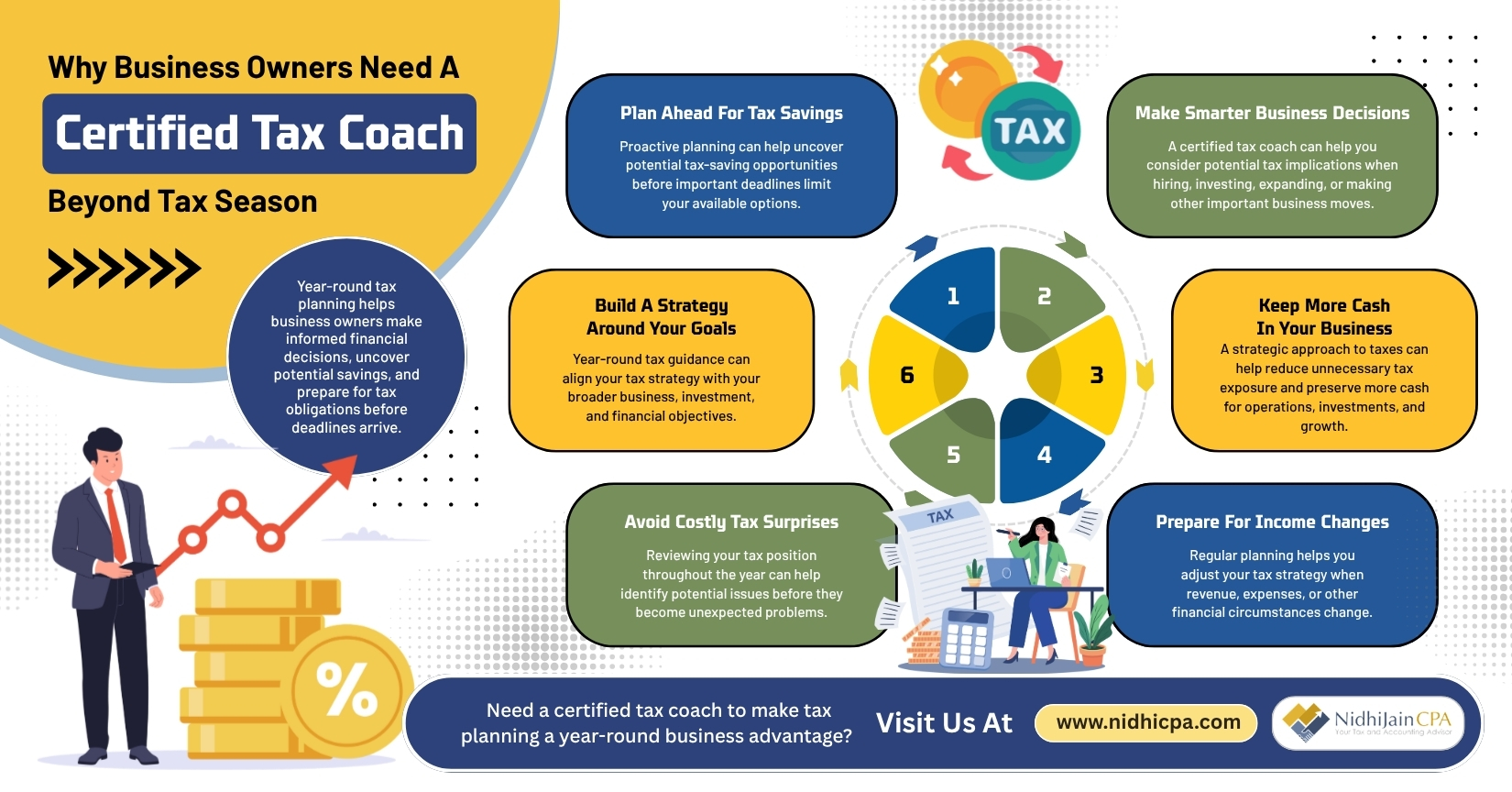
Many business owners think of taxes only during filing season. Once returns are submitted, taxes often move to the bottom of the priority list until the following year. However, working with a tax accountant in California involves much more than preparing and filing tax returns. …