


We use human intelligence to design customized tax plan and optimize your taxes

Helping you make financial savvy decisions

Financial Clarity

Strategic Growth

Continuous
 Support

Proactive Tax Planning

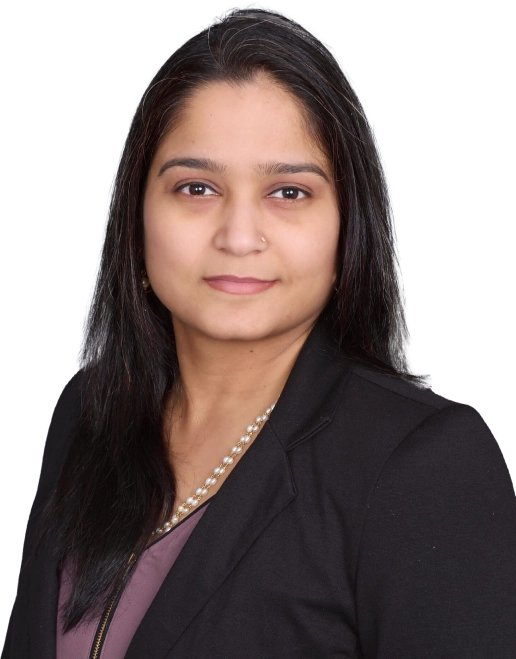
Nidhi Jain Certified Public Accountant & Certified Tax Coach

Do you think you’re paying too much in taxes? Are you tired of seeing your hard-earned money going away in taxes despite tax planning? This is the normal state of most individuals, business owners, and entrepreneurs in San Jose, California.

At NidhiJain CPA, we have back tax solutions that allow business owners and individuals to pay fewer taxes. With the help of our experienced tax advisor, business owners can keep extra of what they earn to themselves. Our international tax accountants assist our clients and help them save hundreds and thousands of dollars yearly. In addition, our tax resolution services offer the same for all our clients in Dublin or San Francisco.

Services We Offer

Welcome To Nidhi Jain CPA

Nidhi Jain CPA, CTC, CA, Master of Commerce (India)

Offers professional and expert guidance for full range of services from personal tax filing to business tax filing with a vision to provide complete tax solutions. Based in Dublin, California, serving clients all over the San Francisco Bay Area.

Our firm is dedicated, responsive, approachable and keen on helping our clients. Our ability to focus on details makes us distinguished.

Our Latest Blogs

Running a business in California has become more expensive than it was just a few years ago. In March 2026, inflation rose to 3.3%, driven largely by higher gasoline prices linked to global supply disruptions. Rising fuel prices, higher borrowing costs, and increasing payroll expenses continue to put pressure on businesses across the state. When expenses rise this quickly, tax planning becomes more important than ever. Waiting until tax season can mean missed deductions, cash flow challenges, and higher tax bills. …

The thought of an IRS audit can make any taxpayer nervous. While audits are relatively uncommon, certain reporting patterns and inconsistencies can increase IRS audit risk. Understanding these common red flags can help individuals and business owners file more accurately and reduce the likelihood of attracting unwanted attention from the Internal Revenue Service.

It is important to remember that an audit does not automatically mean wrongdoing. In many cases, the IRS simply wants clarification or supporting documentation. However, accurate reporting and proper recordkeeping remain essential.

Significant Income Reporting Discrepancies

One of the most common audit triggers occurs when information reported on a tax return does not match records received by the IRS.

Examples include:

  • Missing W-2 income
  • Unreported 1099 earnings
  • Incorrect investment income reporting
  • Discrepancies between tax returns and third-party records

The IRS uses automated systems to compare reported income against information submitted by employers, banks, and other entities. Even small mismatches can generate questions.

Excessive Deductions Relative to Income

Claiming legitimate deductions is an important part of tax planning. However, deductions that appear unusually large compared to reported income may increase audit scrutiny.

Common areas include:

  • Business expenses
  • Charitable contributions
  • Home office deductions
  • Vehicle expenses

A tax planning consultant in Bay Area can help ensure deductions are properly documented and supported by records if questions arise later.

Repeated Business Losses

Businesses occasionally experience losses, particularly during startup years or periods of economic uncertainty. However, reporting losses year after year may attract additional attention.

The IRS may question whether:

  • The activity is being operated as a business
  • The business has a profit motive
  • Expenses are being classified correctly

This is one reason many business owners work with a tax accountant professional to maintain accurate records and reporting practices.

Cash-Intensive Businesses

Businesses that handle large amounts of cash often face higher audit risk because cash transactions can be more difficult to verify.

Examples include:

  • Restaurants
  • Retail operations
  • Personal service businesses

Accountant reviewing business financial statements and tax documents

Maintaining organized bookkeeping records and strong internal controls can help demonstrate accurate income reporting. Reliable bookkeeping practices play an important role in supporting compliance.

Mathematical Errors and Incomplete Returns

Simple mistakes remain one of the easiest ways to attract IRS attention.

Common errors include:

  • Incorrect calculations
  • Missing schedules or forms
  • Wrong Social Security numbers
  • Filing status mistakes

Carefully reviewing returns before submission helps reduce avoidable issues. Many taxpayers rely on tax and accounting services to improve accuracy and minimize filing errors.

Large International Transactions

International reporting requirements continue to receive significant IRS attention. Foreign accounts, overseas investments, and certain international financial transactions often require additional reporting.

Failure to disclose required information can create compliance concerns and increase audit risk. Working with an international tax accountant in Bay Area can help ensure reporting obligations are met correctly.

Reducing IRS Audit Risk Through Good Tax Practices

While no strategy can guarantee that an audit will never occur, several practices can help reduce risk:

  • Maintain complete financial records
  • Report all income accurately
  • Keep supporting documentation for deductions
  • Reconcile financial statements regularly
  • Use proactive tax planning services

Businesses that prioritize accurate bookkeeping and consistent reporting are generally better positioned if questions arise.

Stay Prepared with Professional Tax Guidance

Understanding the factors that contribute to IRS audit risk allows individuals and businesses to take a more proactive approach to compliance. At Nidhi Jain CPA, we provide strategic tax planning in Bay Area, and comprehensive solutions to help clients navigate tax obligations with confidence. Whether you need assistance with reporting, compliance, or long-term planning, our goal is to help you stay prepared and reduce unnecessary tax risks. Contact us today to learn more.

Receiving a notice from the Internal Revenue Service (IRS) can be stressful for both individuals and business owners. Whether the notice relates to a filing discrepancy, unpaid taxes, or a request for additional information, many people are unsure how to respond. This is where IRS representation becomes valuable. …

Frequently Asked Questions

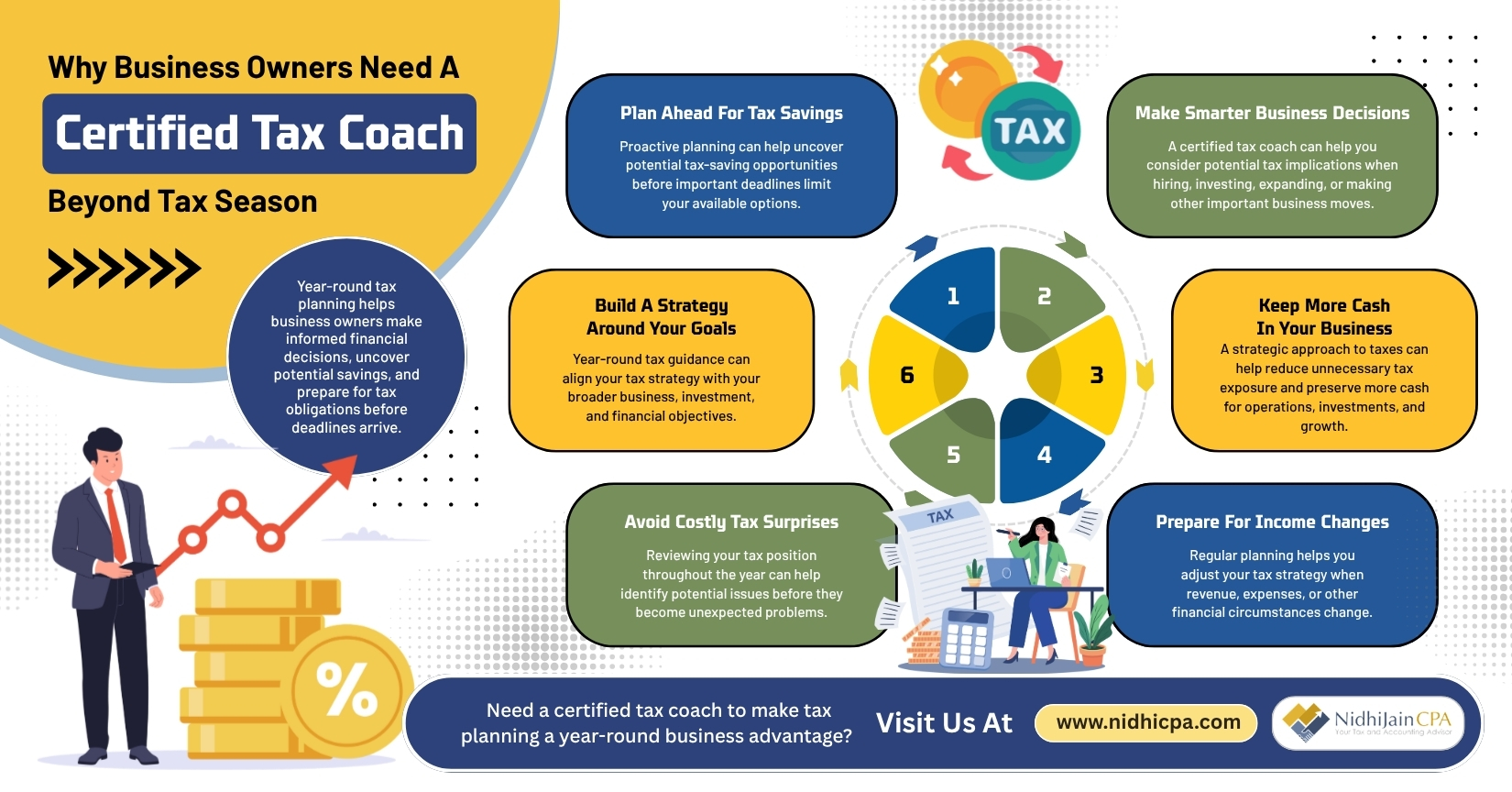
A Certified Tax Coach (CTC) is a qualified individual who has achieved higher training in pre-emptive tax planning. They are experts in finding credits, loopholes, deductions, and advanced strategies to assist their clients in paying less tax.

A Certified Tax Coach (CTC) ensures that they work with you during the entire year. They will make sure you acquire the long-term proactive benefits you require. A certified tax coach is committed entirely to your financial gain and goes above and beyond what a conventional tax preparer or accountant can do. Their chief purpose is to save you as many dollars on taxes as they can and confirm you never overpay.

The main reason is that you get to save money. Secondly, they work hand-in-hand with their clients to look at their tax history and create profiles to help them uncover new money-saving opportunities. Thirdly, they help you find the right opportunities to complement your tax-saving strategy.

A standard CPA and an Enrolled Agent are advanced educational designations in accounting and tax preparation that authorize them to embody you to the IRS. Along with getting these standard qualifications and tax degrees, a Certified Tax Coach must also complete a detailed education focusing on long-term, significant impact proactive tax planning strategies. In addition, a Certified Tax Coach must follow the American Institute of Certified Tax Coaches Code of Ethics, which guarantees that the tactics and ideas that are being used stay within the limitations of the law

Once you create a proactive tax strategy and develop a strong relationship with your Certified Tax Coach, you get to take advantage of their years of training and expertise. The deal with working with a Certified Tax Coach is getting your tax returns at the end of the year. There is a tax maintenance program. This program is designed to give you ever-ready access to a Certified Tax Coach. It permits you to experience a minimum amount of tax liability yearly and continue to weigh your situation accordingly.

Proactive tax planning allows you to work with a qualified financial expert to ensure that you use your tax code to the greatest advantage. On the other hand, tax filing is when you prepare and submit your tax return to the IRS on a deadline. Tax planning is more long-term – it allows you to look into the future, plan better and benefit from the tax rules. It’s a continuing course that will help you evaluate your prior tax returns and existing financial standing to guarantee forthcoming returns. It is different for each individual and organization.